
By Md. Shahidul Islam from Rajshahi
Introduction
The Barind region is one of the most water-stressed areas of Bangladesh. In this drought-prone landscape, agricultural practices and livelihoods have evolved around recurring water scarcity. Although Barind was once a fertile and water-rich region in ancient times, its natural balance has gradually deteriorated due to development interventions that ignored local diversity, people’s voices, and indigenous water systems. Excessive dependence on groundwater extraction, without prioritizing surface water and natural recharge systems, has intensified the crisis. As a result, water rights have diminished and water inequality has increased.
Water is not merely a natural resource; it is fundamental to life, health, livelihoods, food security, ecosystems, and human dignity. International human rights frameworks such as the Universal Declaration of Human Rights (UDHR), the International Covenant on Economic, Social and Cultural Rights (ICESCR) General Comment No. 15, and Sustainable Development Goal (SDG) 6 recognize access to water as a fundamental human right. The Constitution of Bangladesh also obliges the state to protect the rights to life, health, and livelihood. Viewed through this framework, the water crisis in the Barind region has now evolved into a profound human rights crisis.
The Barind region historically refers to an ancient geographical area spanning parts of northern Bangladesh and West Bengal in India, including Rajshahi, Rangpur, Bogura, Pabna, and Malda, once part of the Pundra and Gauda kingdoms. It is characterized by distinctive red and grey soils. In present day Bangladesh, the Barind region mainly includes parts of the Rajshahi and Rangpur divisions.
Reality of Water Management in Barind and People’s Voices from the Public Dialogue
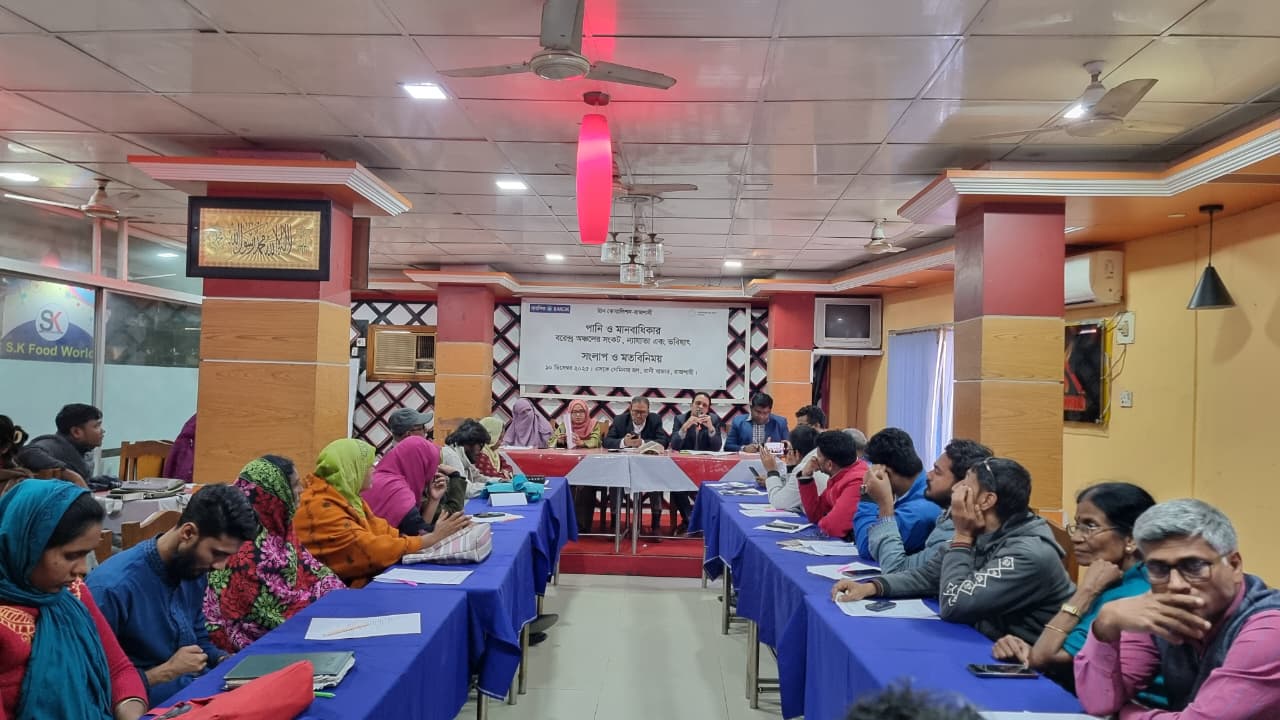
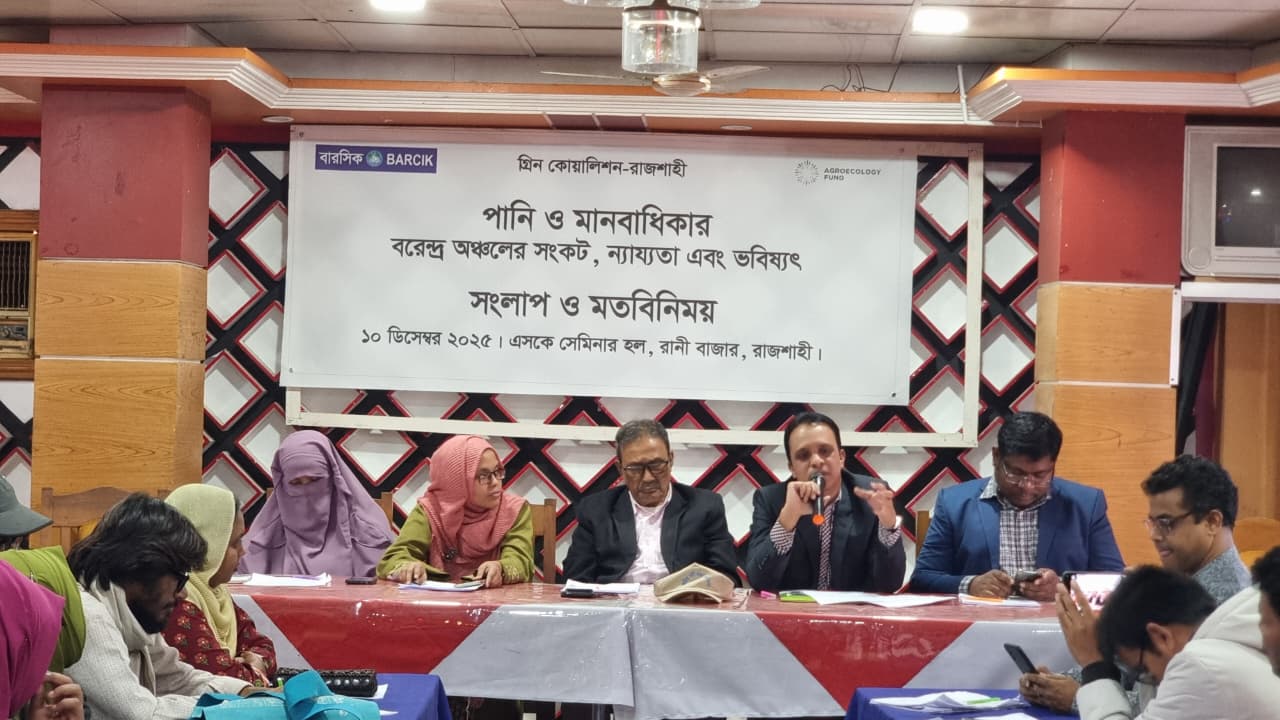
Recently, BARCIK and the Barind Region Green Coalition organized a public dialogue titled “Water Inequality and Human Rights in the Barind Region: Crisis, Framework, and the Way Forward” in Rajshahi. The event brought together government and non-government experts, officials, farmers, women farmers, youth, indigenous community members, and representatives from diverse professions.
At the outset, BARCIK researcher and regional coordinator Md. Shahidul Islam presented an analytical concept paper on water management and human rights in the Barind region. The review highlighted that the situation in Barind Bangladesh’s driest and most water-deprived area, is no longer merely an environmental concern but a serious human rights issue.
Article 25 of the UDHR affirms the right to an adequate standard of living, while ICESCR General Comment No. 15 clearly recognizes access to water as essential for human dignity. SDG 6 reiterates the global commitment to ensuring safe water for all. Bangladesh’s Constitution, through Articles 15, 18, and 31, indirectly and directly links access to water with fundamental rights, including life, health, and social security none of which can be realized without safe and sufficient water.
The analysis further noted that rapidly declining groundwater levels, uncontrolled irrigation through deep tube wells, frequent droughts, and the rising cost of drinking water, especially for poor households, is placing citizens’ fundamental rights at risk. Without water, the right to life becomes unattainable, food security collapses, health systems fail, and local economies struggle to survive.
On 6 November 2025, the government issued a gazette notification banning the extraction of groundwater for purposes other than drinking in 4,911 mouzas across Rajshahi, Naogaon, and Chapainawabganj districts. Irrigation using groundwater was completely prohibited, pushing farmers into deep uncertainty. Farmers expressed concern that low-water-dependent Robi crops and fruit orchards would be severely affected. The gazette declared large areas of 215 unions across 25 upazilas as water-scarce zones for the next ten years, with 1,469 mouzas classified as extremely critical, 884 as highly critical, and 1,240 as moderately critical.
The Barind Multipurpose Development Authority (BMDA) currently operates nearly 18,000 deep tube wells across Rajshahi and Rangpur. Speaking at the dialogue, Syed Zillur Rahman, Executive Engineer of BMDA’s irrigation division, said the institution is reassessing its operations following the gazette notification and is exploring alternative surface water sources. Environmental activist Rasheed Ripon argued that groundwater depletion is largely driven by industrial use and large-scale pond excavation for commercial agriculture, and that farmers should not bear sole responsibility. He stressed that abruptly halting agriculture in a region that depends on farming is unrealistic without viable alternatives.
Environmental campaigner Afzal Hossain stated that equitable distribution and proper use of Padma River water could address Barind’s water crisis, but the government has failed to take decisive action, instead restricting farmers’ agricultural activities. In an emotional testimony, indigenous Mahali woman farmer Chichilia Hembrom from Mondumala, Tanore, described walking long distances to collect water, enduring physical pain, harassment, and humiliation. “When my child cries for a glass of water and I cannot give it immediately, my heart breaks,” she said tearfully.
SUJAN President Ahmed Shafiuddin said that water policies are often imposed top-down, ignoring the lived realities of Barind’s people, leading to systematic human rights violations. Women’s rights leader Kalpana Roy discussed that women suffer disproportionately, as long journeys to collect water expose them to safety risks and deepen gender-based discrimination. On the other hand, Green Coalition President Mahbub Siddiqui emphasized that any water and agricultural planning for Barind must involve local elders and experienced community members rather than being imposed hastily.
While Rajshahi University Associate Professor of Anthropology Avijit Roy shared research findings showing that water in Barind is deeply intertwined with life, culture, agriculture, and politics. He stressed that reducing water inequality requires participatory planning with local communities. Additional perspectives were shared by representatives from the Bangladesh Water Development Board, Rajshahi WASA, Barind Youth Forum, YAS, social welfare organizations, Water Youth Parliament, journalists, writers, and community leaders.
Key Findings from the Dialogue
The Barind region faces compounded challenges due to climate change, uncontrolled groundwater extraction, overreliance on deep tube wells, drying rivers and wetlands, increasing droughts, and erratic rainfall. As a result:
- Marginalized rural households are deprived of basic access to water;
- Crop diversity and agricultural productivity are declining;
- Women and children spend excessive time and labor collecting drinking water;
- Heatwaves combined with water scarcity are increasing health risks;
- Poor and marginalized communities face multiple layers of discrimination.
This is not merely a water shortage rather it is water inequality, where access is determined by socio-economic status, geographic location, political power, and structural injustice.
Water, Human Rights, and the Barind Region
Bangladesh is a signatory to multiple international human rights treaties that obligate the state to protect the rights to water, life, and dignity. UDHR Article 25, ICESCR General Comment No. 15, SDG 6, and constitutional provisions collectively affirm that access to safe water is non-negotiable. Without water, the rights to life, health, food, environment, and dignity cannot be realized.
Forms of Human Rights Violations in Barind
Prolonged water scarcity has led to systemic human rights violations, including forced water commodification, economic inequality, marginalization of small and indigenous farmers, water-related conflicts, gendered burdens on women and children, destruction of recharge zones, increased malnutrition, and public health risks. These conditions threaten present populations and the rights of future generations.
Public Demands and Policy Recommendations
Key recommendations emerging from the dialogue include:
- Legal recognition of water as a human right;
- Reform of BMDA and water governance laws to reflect Barind’s realities;
- Development of a dedicated Water Justice Plan for the Barind Region;
- Inclusion of indigenous knowledge and cultural practices in water policy;
- Strict regulation of groundwater extraction;
- Equitable water distribution for small and marginal farmers;
- Restoration of ponds, wetlands, canals, and natural reservoirs;
- Protection of groundwater recharge zones and promotion of rainwater harvesting;
- Inclusive policy-making involving women, indigenous peoples, farmers, and youth;
- Diplomatic initiatives to ensure equitable sharing of transboundary rivers, including the Padma.
Conclusion
Addressing the water crisis in the Barind region is not merely about saving a region rather it is about safeguarding human rights for present and future generations. Without water rights, all other human rights become hollow. As this year’s Human Rights Day theme, “Our Everyday Essentials,” reminds us, water is the most fundamental necessity of all. The time has come to end water inequality and establish water as a legally and morally protected human right in Bangladesh.