
By Suparna Mitra from Shymnagar, Satkhira
As climate change continues to intensify risks for women and girls, BARCIK–ENGAGE Project has taken a strategic initiative to build collective resistance against digital violence. With co-funding from the European Union and in collaboration with NETZ- Partnership for Development and Justice, BARCIA-ENGAGE project successfully implemented a 16-day campaign against gender-based violence from 25 November to 10 December. This year’s national theme—“Unite to End Digital Violence against All Women and Girls”—strongly reflects the urgent need to ensure women’s safety, dignity, and freedom in an increasingly digital world. Observed globally since 1991 and in Bangladesh since 1997, the 16 Days of Activism placed special emphasis this year on the interconnectedness of the climate crisis and digital violence.
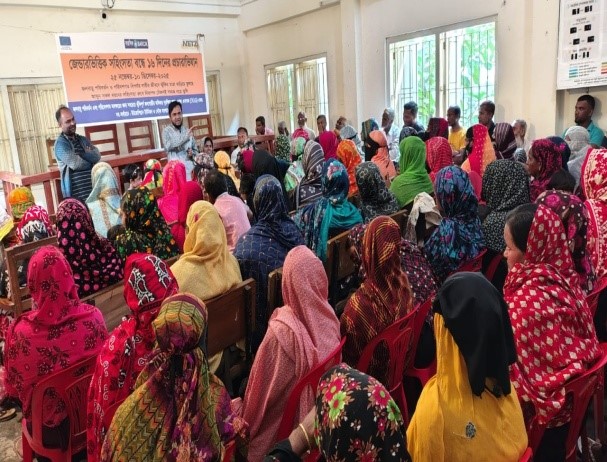
During climate-induced disasters such as floods, cyclones, and droughts, women face heightened vulnerabilities in their daily lives. At the same time, they are disproportionately exposed to digital abuse, including misuse of photos and videos, cyberbullying, and blackmail. Following Cyclone Amphan in 2020, an analysis by UN Women revealed that violence against women increased by up to 65 percent in affected areas—underscoring the severity of this dual crisis.
To address these overlapping challenges, BARCIK–ENGAGE Project implemented 28 awareness-raising activities across 24 unions in four upazilas of Satkhira and Khulna districts in southwestern coastal Bangladesh. Through these initiatives, awareness was raised among approximately 2,800 community people and nearly 1,200 students’ teachers from local educational institutions. Campaign activities included discussions on responsible digital behaviour for youth, community meetings, rallies, and signature campaigns at college level. Participants engaged in in-depth discussions on cyberbullying, online harassment, misuse of photos and videos, blackmailing, fake accounts, and trolling, alongside self-protective digital skills, legal support mechanisms, and referral services. Active participation of adolescent girls and parents made the sessions dynamic and impactful. Nearly 4,500 posters and leaflets were distributed, complemented by courtyard meetings and community rallies to amplify the campaign message at grassroots level.
Mr. Abu Saleh Babu, Chairman of Atulia Union Parishad in Shyamnagar Upazila, stated: “Violence against women on digital platforms has become a major social crisis. Awareness must be strengthened within families, schools, and society at large. If 100 people here become aware today, and each shares this knowledge with another 100, we double our impact. Atulia Union Parishad stands fully committed to ensuring the safety of women and girls.” Mr. Zulfikar Al Mahdi, Principal of Nowabeki College, emphasized: “Students spend a significant amount of time online. Digital safety must therefore be an integral part of education. Digital violence not only causes psychological harm but also erodes self-confidence. This challenge can be reduced if families and educational institutions work together.” At the community level, CSO members shared that many girls remain silent about digital harassment due to fear and shame. This campaign has empowered them to speak up. Community leaders described the courtyard meetings and ongoing awareness initiatives as timely, effective, and impactful. Local government representatives, educators, and community leaders unanimously agreed that digital violence cannot be prevented without joint action by families, schools, and communities.
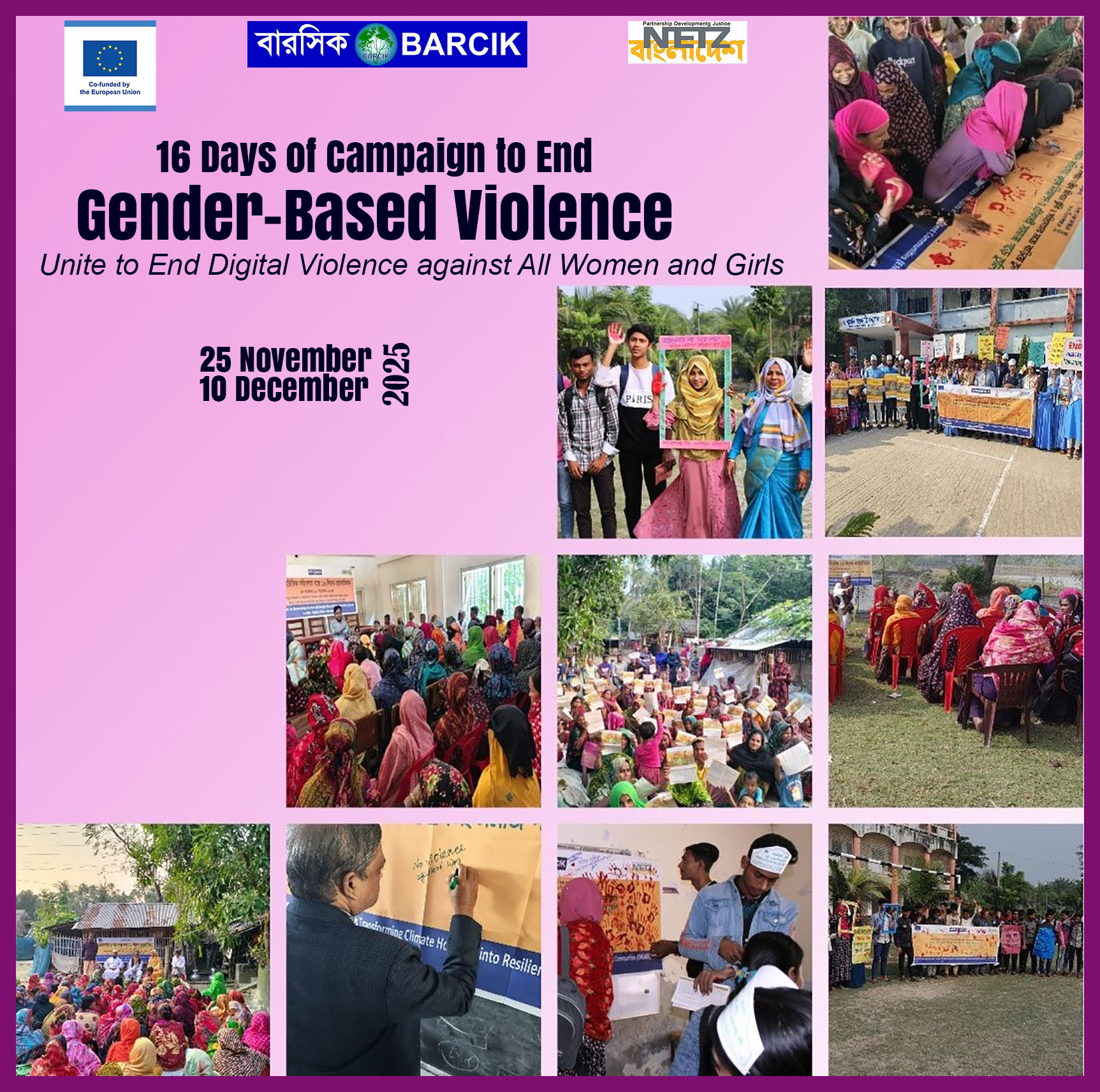
To reinforce the campaign, NETZ-Partnership for Development and Justice published posters and leaflets carrying the message: “Climate change increases the risk of violence in women’s lives—let us unite to end all forms of violence and build a safe and sustainable society.” The campaign poster depicts a woman’s face surrounded by greenery amid scenes of destruction and pollution—symbolizing hope and resilience, and contributing positively to the morale of climate-affected communities.
Overall, this 16-day activism significantly increased community awareness on preventing digital violence and promoted a spirit of collective resistance. It clearly demonstrates that climate justice, environmental human rights, and gender equality are deeply interconnected and mutually reinforcing. Women’s empowerment, equal rights, and environmental human rights together form the foundation of a safe, just, and sustainable society.