
By Amreen Binte Azad from Rajshahi
BARCIK organized a three-day “Capacity Development Workshop on Agroecology, Climate Justice, and Food Sovereignty” in Rajshahi recently. The workshop brought together farmers, women, youth, and environmental activists for an interactive learning experience aimed at understanding local agricultural challenges, climate impacts, and food sovereignty. Key objectives included understanding the core principles of agroecology, analysing climate justice and accountability, and enhancing the advocacy skills of participants regarding pesticide regulations, human rights, and community-led seed systems.
The first day began with an introductory session where participants shared their expectations from the workshop. Participants discussed what they hoped to learn. Shahidul Islam, Regional Coordinator of BARCIK, presented BARCIK’s vision, mission, and work themes, emphasizing the importance of community-based, environmentally conscious social movements for youth, women, and farmers.
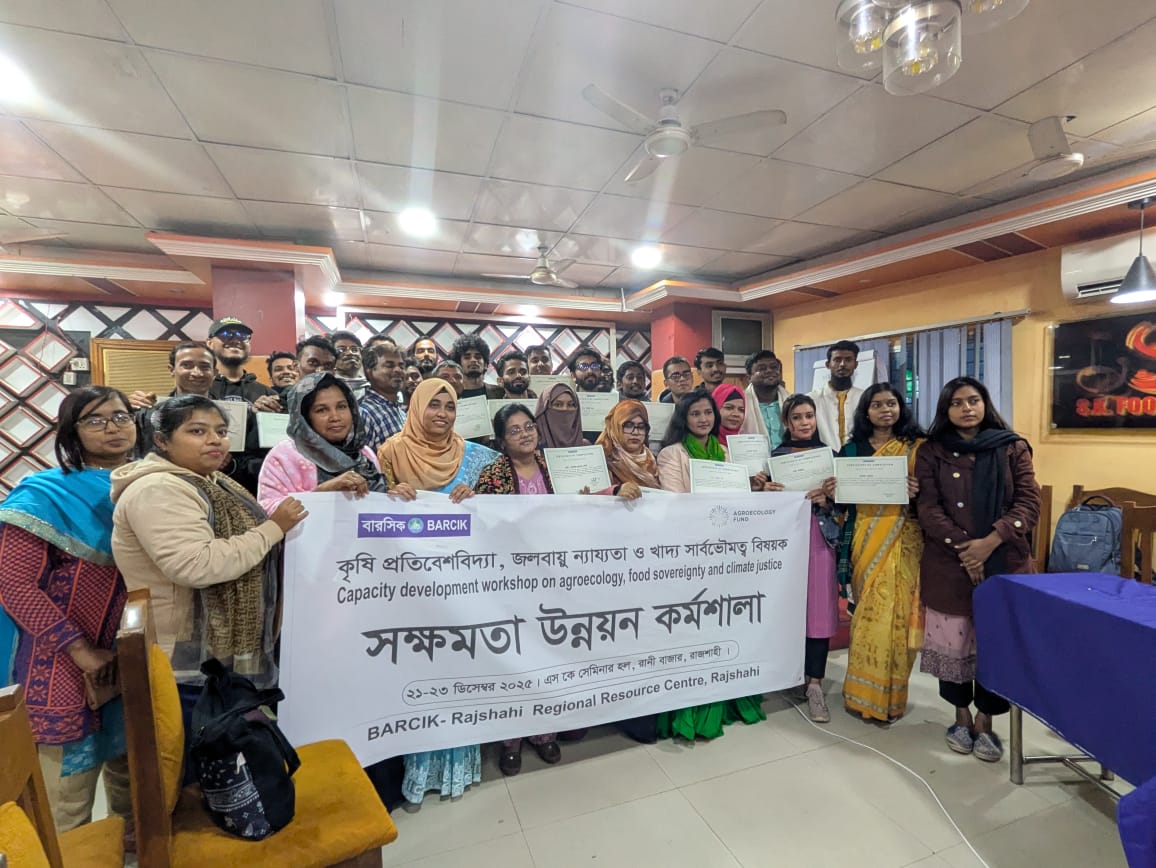
The first session was facilitated by biodiversity expert and former Rajshahi University professor, Dr. Bidhan Chandra Das. He explained the basic concepts of environment, nature, and biodiversity, highlighting how human-centered practices disrupt ecological balance. The second session of the day, led by Professor Dr. Golam Mostafa, Director of the Environmental Science Institute at Rajshahi University, focused on climate change causes and adaptation strategies. He discussed carbon emissions, deforestation, fossil fuel use, and consumerist lifestyles as major drivers of climate crises, and stressed the importance of mitigation, adaptation, and renewable energy solutions.
The second day was facilitated by BARCIK Director and researcher Pavel Partha. He started by drawing from historical examples and argued how food has been used as a tool for war, colonizing and famine. Discussions included the impacts of the Green Revolution and corporate agriculture on farmers and local ecosystems.
In the afternoon, Associate Professor Kazi Robiul Alam from Rajshahi University’s Anthropology Department discussed the gendered effects of climate change. He highlighted that rural and marginalized women often bear the heaviest burdens in water, food, fuel, and care-related labor. However, they have limited access to decision-making, resource control, and policy formation, even though they play a central role in adaptation strategies.
On the final day, Pavel Partha drew examples of different environmental and land conservation movements in our region. In the afternoon, Associate Professor Avijit Roy of Department of Anthropology, Rajshahi University led a session on local agricultural adaptation and equitable solutions in the Barendra region. He challenged the perception of Barendra as merely drought-prone and encouraged viewing it as a historically resilient and resourceful region. Discussions focused on uneven impacts of climate change, farmer autonomy, and the importance of framing agroecology as a social movement.
The workshop stressed that sustainable agricultural and food policies must be built on local, traditional, and indigenous knowledge systems, rather than top-down solutions.
The three-day workshop provided participants with a comprehensive understanding of agroecology, food sovereignty, and climate justice. They reflected that the sessions helped them see these issues as interconnected social, political, and environmental challenges. Participants left the workshop motivated to integrate their learning into field-level work, community advocacy, and program planning, while promoting sustainable farming, local knowledge, and equitable food systems in the Barendra region.