
By Amreto Sarker, from Rajshahi
In Bangladesh, women especially those from marginalized communities still face significant social barriers when choosing livelihoods outside traditional roles. Yet some women overcome these challenges and become sources of inspiration for others. One such woman is Tuli Begum (46) from Pakarmatha Cluster Village in Paba Upazila, Rajshahi, who has transformed her life by becoming a rickshaw driver.
After marrying in 1996, Tuli lived with her husband, a construction worker, and their four children in a rented house in Rajshahi city. The family’s limited income barely covered their daily needs, leaving little opportunity for their children’s education. Tragedy struck when one of her sons died from illness. Later, her daughter returned home after her marriage broke down due to her husband’s drug addiction, while her eldest son started living separately.
The family’s situation worsened during the COVID-19 pandemic in 2020, when her husband abandoned the family and remarried. Left to care for her sick daughter and grandson, Tuli refused to beg. She first sold puffed rice snacks and later balloons near a children’s park, but the income was insufficient. In 2021, with support from local people, she found shelter in a government cluster village and later received a permanent house.
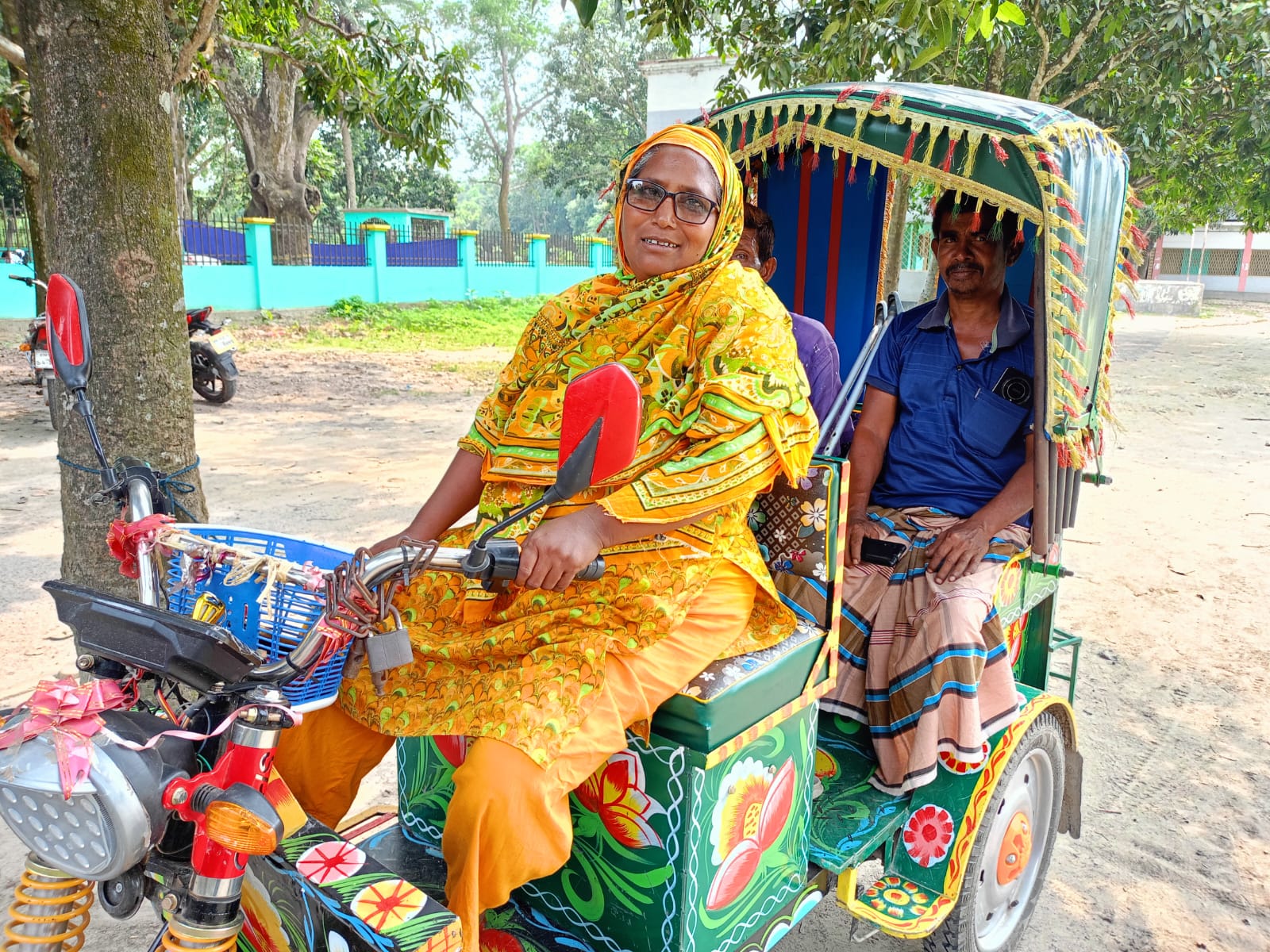
Since her own health deteriorated with chronic pain, balloon selling became impossible. Encouraged by her daughter, Tuli learned to drive a rickshaw in late 2021. Local resident Raihan Kabir Jewel helped her rent a rickshaw on easy terms. On her first day, after paying the rental fee, she earned enough to buy rice and lentils for her family.
The journey was far from easy. Many passengers doubted a woman’s ability to drive a rickshaw, while some male drivers looked down on her. Initially, she transported vegetables instead of passengers to overcome social prejudice.
She said, “I want society to stop judging women for doing honest work. Many women are struggling like me. If my work inspires them to become self-reliant, that will be my greatest achievement.”
Despite the hardships, Tuli’s perseverance gradually changed her life. With assistance from local people, she received a government grant of BDT 20,000 and ownership of a rickshaw, allowing her to repay debts and increase her daily income to BDT 800–1,000.
Today, she supports her daughter’s medical treatment, pays for her grandson’s education, and supplements her income by growing vegetables and raising ducks, chickens, and goats around her home. In 2025, her household was recognized as a Model Shotobari (Homestead), producing safe, pesticide-free vegetables for family consumption.
Tuli Begum’s story is a powerful example of resilience, dignity, and determination, demonstrating that no profession should be limited by gender.