
By Happy Roy from Netrakona
The rhythmic clang of hammer on iron announces life long before one step into the village. The sound tells a story of labor in motion of bellows breathing fire and muscular hands shaping red-hot iron into tools that quietly make every day hard work easier. This is the world of the village blacksmith.
The blacksmith community is one of Bangladesh’s oldest traditional occupational groups. For generations, they have forged essential agricultural tools such as ploughs, hoes, sickles as well as household implements like knives, choppers, and cleavers. Rooted deeply in rural life, this profession has historically been practiced by Hindu communities, though today many Muslims have also joined the trade, gradually reshaping its social boundaries.
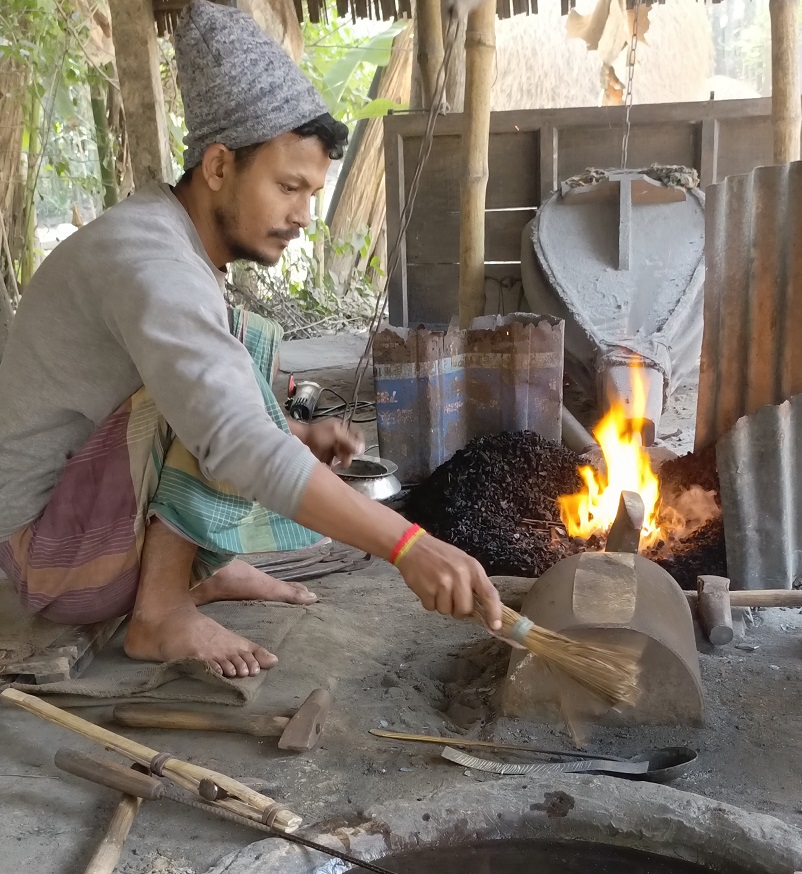
Baishdar village of Lakshmiganj Union is home to both Hindu and Muslim families. Oral history suggests that before independence, the village was inhabited mainly by Hindu and potter communities. Even today, digging into the soil reveals fragments of clay pots and utensils that silently witnesses to a past erased during the 1971 Liberation War, when many families fled the country. Only five blacksmith families remain in Baishdar now, alongside members of the Rabidas community. Old temples still stand as symbols of a fading heritage.
Although the demand for iron tools continues, skilled artisans are becoming rare. In earlier times, blacksmithing passed naturally from one generation to the next. Today, younger family members pursue education, jobs, or business, leaving the forge behind. Modern manufactured tools and rising material costs have further pushed this craft toward extinction. Still, a handful of families struggle on, driven by necessity and pride.
A blacksmith’s workspace is simple, which is often a shed in the courtyard with a roof and open sides. Inside lie the essentials: bellows, hammers, coal, and a large water vessel. Fire fed by coal heats the iron, which is then hammered into shape with remarkable precision.
Iron and coal are the main raw materials, both purchased at rising costs. New iron costs around 80 taka per kilogram, old iron about 70. Coal, once easily found in every household, has become scarce as gas and electric stoves replace traditional wood-fired cooking. Blacksmiths now travel far to collect it.
Every day, the blacksmiths of Baishdar produce machetes, cleavers, chisels, scissors, plough blades, axes, shovels, and sickles. Prices are set by weight. While tools are sold in local markets, wholesalers often buy in bulk at lower prices and resell elsewhere at higher margins. This guarantees sales but reduces the artisans’ profits.
Demand peaks during planting and harvest seasons, when farmers need sickles, hoes, and grass cutters. During Eid-ul-Azha, knives and cleavers sell rapidly. Yet earnings remain modest, as middlemen dominate the market and direct buyers have disappeared.
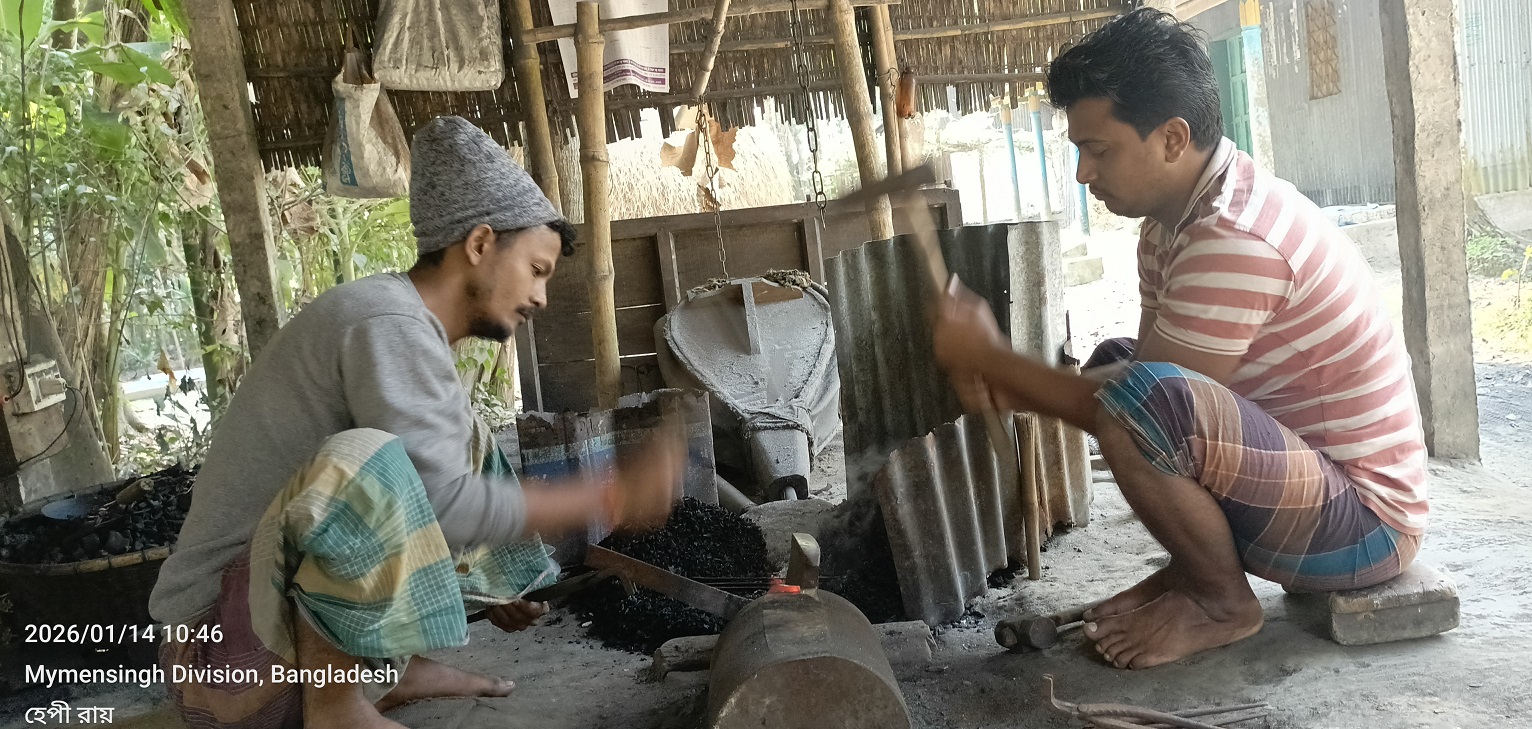
On the other hand, lack of capital prevents blacksmiths from producing and storing tools in advance. In the past, people from nearby villages came directly to blacksmith homes to place custom orders. Today, markets, factories, and even online platforms have replaced that relationship. Modern cutting tools aggressively advertised as time-saving and efficient flood the market, accelerating the decline of handmade ironwork.
Once highly valued in agrarian society, blacksmithing played a vital role in sustaining the rural economy and preserving tradition. Now, modern technology, mechanized production, expensive raw materials, coal shortages, and the younger generation’s disinterest have pushed this heritage craft to the brink of extinction. With collective effort and renewed respect for indigenous skills, the revival of this profession is still possible but time is running out.