
By Sattarajnaj Saha from Harirampur, Manikganj
A two-day training workshop on agroecology and climate justice was held at the Barundi Agroecology Learning Centre in Hatipara Union, Manikganj Sadar, recently organized by local farmers’ groups with support from BARCIK.
The workshop was chaired by Shobha Rani Roy, Director of the Centre, and facilitated by a BARCIK Training and Advocacy Officer Gosai Das Roy, Shahidul Islam, Monowara Begum, Ayesha Begum, BARCIK Regional Coordinator Shimul Kumar Biswas, Sattaranjan Saha and Moynal Haque also participated in the discussions.

Farmers shared experiences on reducing dependence on external inputs, improving soil health and conserving biodiversity. They discussed compost production, seasonal and mixed cropping, local seed conservation and the use of organic inputs according to soil conditions. They said that healthy soil is essential for the wellbeing of all living beings.
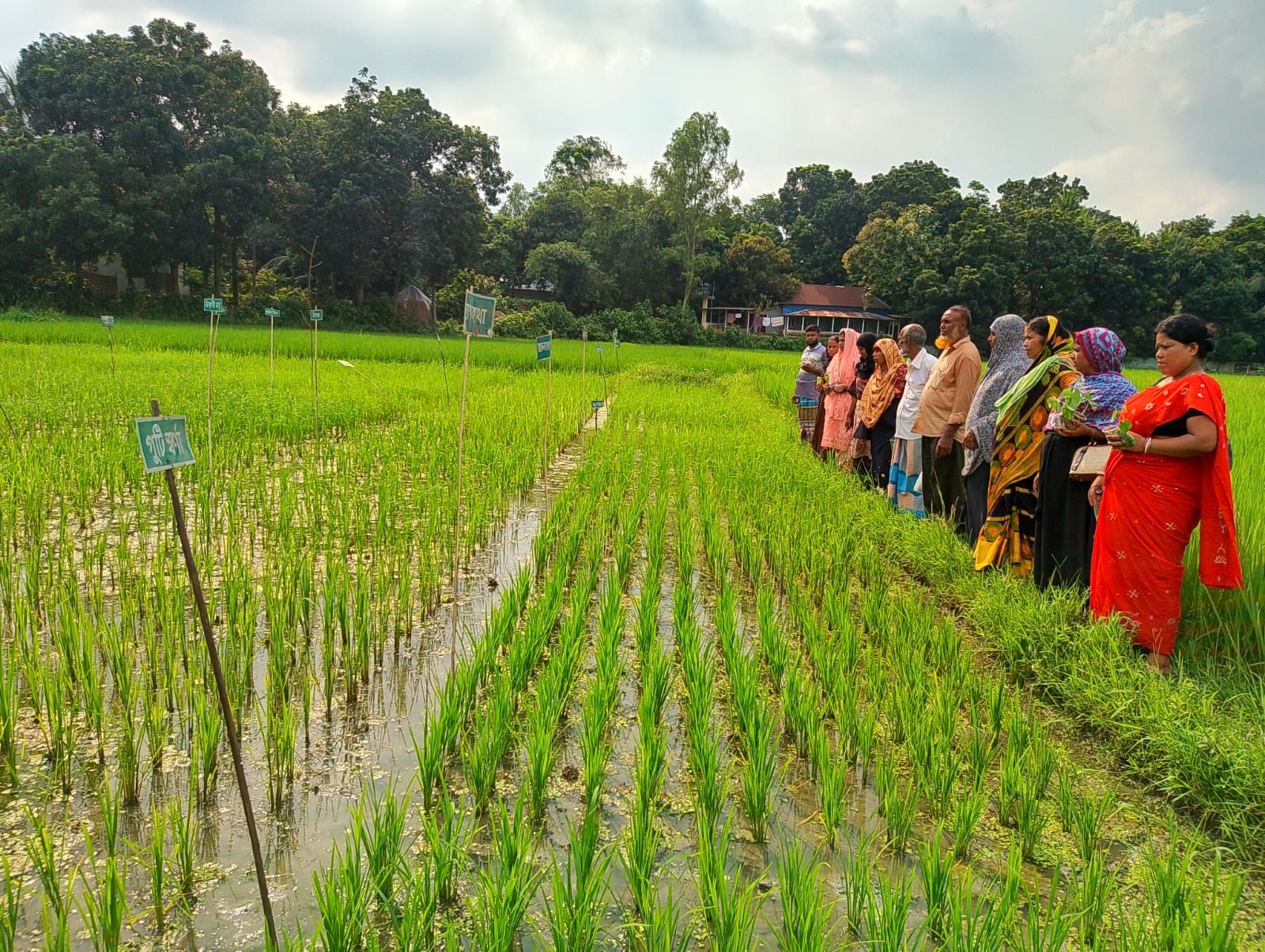
Participants also highlighted local farming practices that help communities adapt to climate variability. During the rainy season, farmers cultivate traditional rice varieties such as Hijal Digha, Digha and Bhauyala in waterlogged fields. After the rice harvest, they save seeds for the next season. Following the monsoon, they cultivate crops such as chilli, black cumin, coriander, fenugreek, onion, garlic and pulses on nutrient-rich silted land.
Women play a particularly important role in conserving and exchanging seeds. Farmers consider seeds safer in women’s hands because women traditionally manage seed conservation, exchange and varietal diversity. They said that access to local seeds strengthens farmers’ independence and supports biodiversity.
Participants also discussed climate-adaptive practices, including growing climbing vegetables on raised homesteads, deep-bed cultivation and conserving locally adapted seeds. These traditional practices help farmers respond to floods, waterlogging and other climate-related risks while protecting nature and local biodiversity.
After the workshop, participants visited the Centre’s seed bank, vermicompost unit, homestead vegetable and spice gardens, farmer-led rice research plots, ginger cultivation in sacks and indigenous poultry-rearing activities. Farmers also exchanged seedlings of locally preserved bottle gourd, Naldog, Koia bean and Pushti bean.