
By Shahidul Islam from Rajshahi
Agriculture in Bangladesh is currently going through a deep crisis. On the one hand, climate change, drought, erratic rainfall, and water scarcity are creating growing challenges. On the other hand, a production system dependent on corporate seeds, chemical fertilizers, and pesticides is steadily pushing farmers into greater dependence on the market. In this context, the movement to return control of agriculture to farmers is finding one of its most effective tools in agroecology learning centers.
The Barind region is one of the most environmentally vulnerable areas in Bangladesh. For a long time, farmers here have been struggling with drought, declining soil fertility, and rising production costs. There was a time when agriculture in this region was based on indigenous seeds, crop diversity, and nature-dependent practices. As these practices gradually disappeared, the agricultural system became increasingly fragile. In response, the non-governmental development organization BARCIK (Bangladesh Resource Centre for Indigenous Knowledge) has worked with local farmers in the Barind region to help establish a total of ten agroecology learning centers.
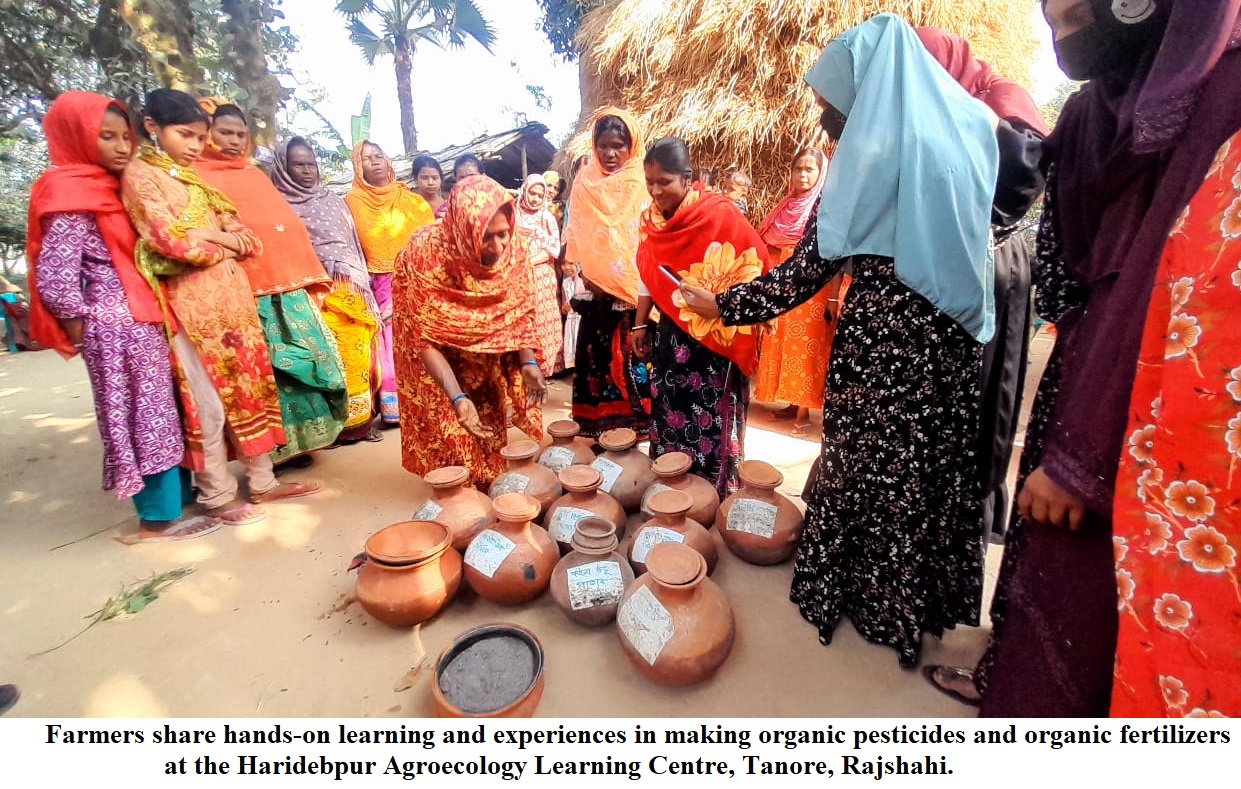
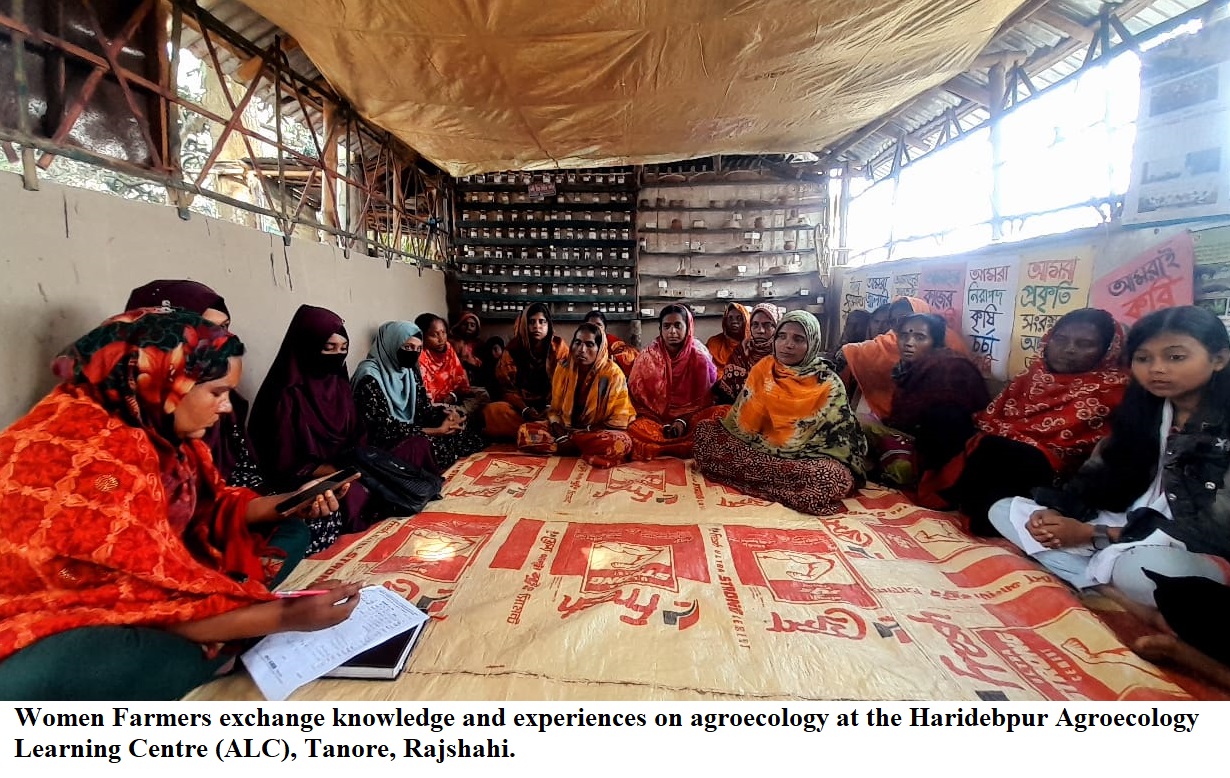
Agroecology Learning Centers (ALCs) are essentially field-based schools where farmers use their own land as classrooms to learn farming methods that work in harmony with nature. There are no formal classrooms or fixed curricula; instead, learning takes place through experience-sharing, experimentation, and collective learning. Farmers learn how to grow crops using less water, how to protect soil health, and how to build sustainable agriculture based on indigenous seeds. Alongside this, discussions also take place on protecting local ecosystems, accessing government services, and understanding farmers’ rights.
Closely linked to these learning centers are community seed banks. With BARCIK’s support, community seed banks in the Barind region have strengthened the foundation of agricultural sovereignty. At the agroecology learning centers, farmers are not only learning production techniques; they are also learning the importance of seed conservation, selection, and exchange. As a result, seeds are no longer merely products of external companies but are returning as farmers’ own resources. Farmers exchange knowledge and experience on making organic fertilizers and biopesticides to ensure safe agriculture. Jitendra Nath, a farmer who manages the Gokul Mathura Agroecology Learning Center in Tanore upazila of Rajshahi, explains:
“Here we share experiences on how to preserve indigenous as well as improved seeds. At the same time, we learn how to make biopesticides using neem, mahogany, bean leaves, and other plants, and how to prepare and use organic fertilizer, vermicompost, and quick compost. These are not just lessons—we practice them and apply them in our fields.”
Through these learning centers, farmers are gradually returning to indigenous and improved local seeds. Agroecology learning centers are playing a crucial role in preventing the extinction of indigenous seeds. Mosa Sultana Khatun, a woman farmer who manages the Agroecology Learning Center in Bilnepal Para of Paba upazila, says that their center has conserved 185 varieties of seeds. Direct observation shows that a community seed bank has also been established there. The collection includes seeds and plants ranging from rabi crops to swamp taro (alkushi), amla, tulsi, kalokasinda, khesari, barley, foxtail millet (kaun), linseed (tishi), various rice varieties, vegetables, flowers, fruits, forest species, and medicinal plants. She explains that from the community seed bank, seeds are used personally and also exchanged with neighbors. Their goal is to conserve indigenous seed varieties and keep them alive. On the ground, it can be seen that neighbors take seeds as needed and sow them in their home yards or fallow land. At the end of the season, they collect seeds again from those plots. In this way, families produce a variety of safe and nutritious vegetables throughout the year. Farmers are encouraged to use vermicompost and organic biopesticides (environment-friendly pest control) for safe food production. Inspired by these activities, farmers from different villages in the union are now conserving a wide range of seeds. Seed conservation is meeting families’ vegetable needs while also allowing them to earn income by selling surplus produce. Alongside this, she is engaged in awareness-raising work on women’s rights, women’s empowerment, gender equality, recognition of women’s labor, the importance of women in society, and the development of women’s leadership.
One major contribution of agroecology learning centers is the reduction of chemical dependency. Farmers learn how to use organic manure, cow dung, vermicompost, and natural pest control methods. This lowers production costs, improves soil fertility, and reduces environmental pollution, while creating opportunities to produce safe and nutritious food.
These learning centers have also become important platforms for rural women. In many cases, women are leading seed conservation, vegetable cultivation, and household food management. Agroecology learning centers make women’s knowledge and experience visible and recognize their role in agriculture.
The learning centers are also playing an important role in reducing carbon emissions in the context of climate change. Field observation shows that Kabuljan, a woman farmer who manages the Prasad Para Agroecology Learning Center in Tanore upazila, has invented a low-carbon, environment-friendly clay stove. So far, she has taught more than three thousand people in her surrounding areas and across the Barind region how to build these stoves. Today, more than seven thousand families are using these eco-friendly stoves.
Economically, this initiative is having a positive impact on farmers. As the need to buy seeds, fertilizers, and pesticides from the market decreases, farmers’ cash expenses are reduced, helping them escape-at least partially from debt traps. Many farmers are now exchanging their own produced seeds with neighbors, which is also strengthening social bonds.
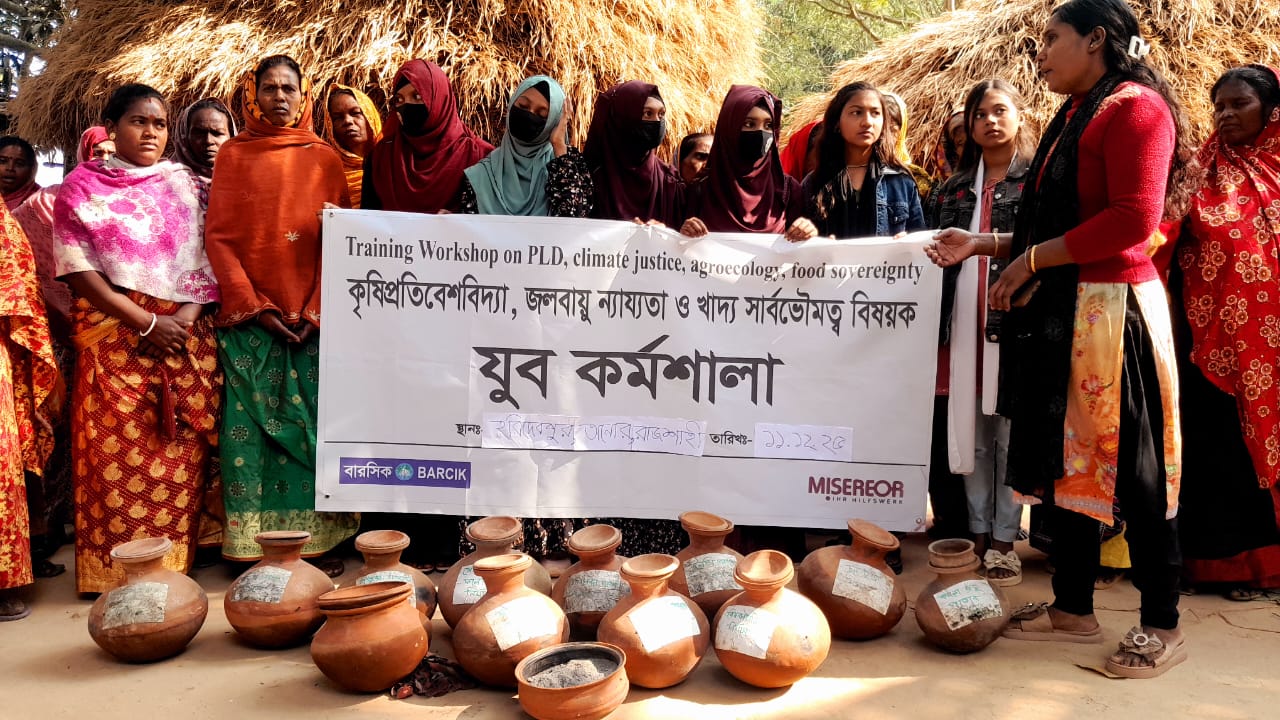
Agroecology learning centers are not just training spaces; they are places where farmers are reclaiming control over seeds, knowledge, and production systems. In the Barind region, these centers are strengthening indigenous seed systems, reducing market dependence, and developing locally appropriate solutions to address the climate crisis, thereby rebuilding agricultural sovereignty. With state recognition and policy support, agroecology learning centers could become an effective national model for protecting agricultural sovereignty, climate resilience, and farmers’ rights.
Overall, the impacts of climate change, the lack of adequate policy support, and the limited inclusion of agroecology within agricultural extension systems remain major challenges. Farmers believe that if these learning centers receive formal recognition and support from the state, agricultural sovereignty will be further strengthened. Taken together, agroecology learning centers in the Barind region are not merely training initiatives; they represent a social movement for farmers’ rights, seed freedom, and sustainable agriculture. By returning knowledge and control to farmers, these learning centers have emerged as a new force in safeguarding agricultural sovereignty.