
By Md. Nazrul Islam from Manikganj
For generations, the rhythm of life in Bangladesh has followed the monsoon, rivers, tides and seasons. Ashar and Shraban the traditional months of heavy rainfall once brought predictable cycles of water and fishing. Today, that rhythm is increasingly uncertain.
Erratic rainfall, sudden floods, droughts, heatwaves and other climate-related events have become increasingly common. Across rural Bangladesh, marginal farmers and fishing communities are among those who bear the greatest burden, adapting their lives and livelihoods to conditions they have little power to control.
The nature of the crisis varies from region to region. Coastal communities struggle with increasing salinity, while northern areas face severe heat and drought that threaten crops and biodiversity. Around Dhaka, embankments, unplanned dredging and the filling of ponds, canals and other natural drainage systems have intensified waterlogging.
Manikganj, close to the capital, is also experiencing these changes. In Ghior upazila’s Nali Union, the villages of Gangdubi and Diyal offer a glimpse into how climate and environmental changes are reshaping everyday life.
When fuel security becomes part of survival
Gangdubi is traditionally a low-lying village. Its name itself reflects its relationship with water. Older residents recall a time when water remained in the area almost throughout the year. Today, that is no longer the case, but sudden floods and untimely rainfall remain constant threats. For the fishing community, preparing for these uncertainties includes something as basic as securing household fuel.
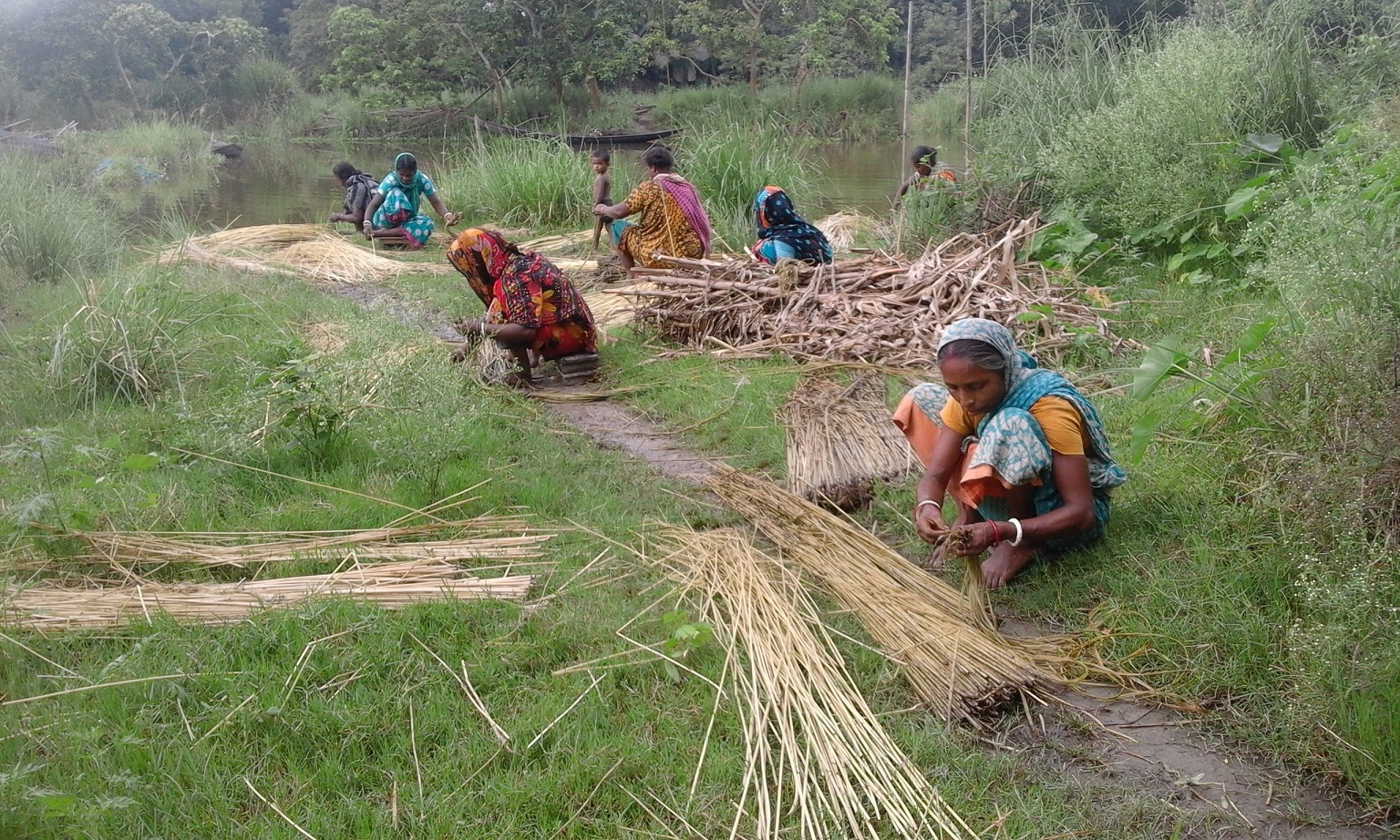
In the fishing neighborhood, women and men are currently busy processing Bachna jute. Eighty-year-old Lakshmi Rani Rajbanshi has spent much of her life making use of this seasonal resource. “We get the opportunity to collect Bachna jute only once a year,” she explains. “The smaller jute plants are cut and retted. We remove the fibre and give it to farmers, and in return we receive the jute sticks.”
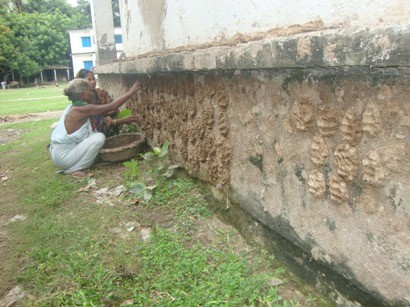
For her family, these jute sticks are much more than agricultural by-products. They are a valuable household resource. She further said, “We use them for fencing around our homes, kitchens and toilets. Most importantly, we use them to start the cooking fire throughout the year. Those who do not collect them buy jute sticks from us for Tk 3,000 to Tk 3,500. This gives us some additional income, while we do not have to spend money buying fuel ourselves.”
For families living on limited incomes, such practices can make a significant difference. Another resident, Bimala Rajbanshi, says they are also using shiker chula, a traditional improved cooking oven that can burn cow-dung sticks and other locally available fuel. The oven helps to reduce fuel consumption while producing less smoke.
These practices may appear simple, but for households facing rising costs and environmental uncertainty, they represent an important form of local adaptation.
A disappearing tree and a fishing tradition
For fishing families, the river is not simply a source of income; it is also a workplace, a food source and a way of life. Much of their time is spent on boats, where fishing, cooking and even resting are part of everyday existence.
Nedhuram Majhi explains that while women traditionally manage cooking and household activities, men spend considerable time repairing boats, nets, bamboo equipment and other fishing gear. During the monsoon, nets remain in water for longer periods and need additional protection. Fishermen traditionally use the fruit of the gab tree to treat and strengthen fishing nets, while boats are coated with tar.
But the gab tree itself is becoming increasingly difficult to find. “I walk from tree to tree looking for gab, but there are far fewer trees than before,” Nedhuram says. “People are interested mainly in timber plantations now. If I had land, I would plant gab trees myself. The tree helps extend the life of fishing nets, and its bark and other parts can also be used as fuel.”
His concern points to a wider connection between biodiversity and livelihoods. The disappearance of a single tree species can affect the environment and traditional occupations and household economies. Nedhuram says that because water no longer remains in the river throughout the year, many fishers have had to lease other people’s land and take up farming. “If we want to protect the traditional occupation of fishing, we have to protect natural resources,” he says. “Women need access to sufficient household fuel, and the rivers need to retain water and flow throughout the year.”
When a river becomes a canal
In nearby Diyal village, 72-year-old fisherman Bongkeshwar Rajbanshi remembers a very different Khirai River. “The river beside our homes is no longer really a river; it has become a canal,” he says. “Once, its water was clear, clean and sweet. The puti fish of the Khirai were famous.”
The fish were so renowned that local people still recall a saying that the taste of Gangdubi’s Khirai puti fish and fried greens was fit even for kings and queens.
Ajit Rajbanshi, 60, remembers another tradition. He said, “Every year during Ashwin and Kartik, a huge market for puti fish would take place here. It felt like a festival. People came from far away with polo, dharma jal and jhanki jal to catch fish.” That atmosphere has largely disappeared.
With reduced water flow and weaker currents, fish populations have declined. Changes in farming have added another pressure. Traditional Aman and Aus rice cultivation has decreased, while maize cultivation has expanded. Farmers seeking higher yields and quick returns increasingly use chemical fertilizers and pesticides, which local fishers fear are damaging aquatic ecosystems and reducing fish stocks. For the fishing community, the decline of the river is therefore also the decline of a livelihood, a food culture and a body of local knowledge.
What will remain for the next generation?
Older fishers know that the past cannot simply be brought back. They also worry that younger generations are increasingly reluctant to continue the occupation of their parents and grandparents.
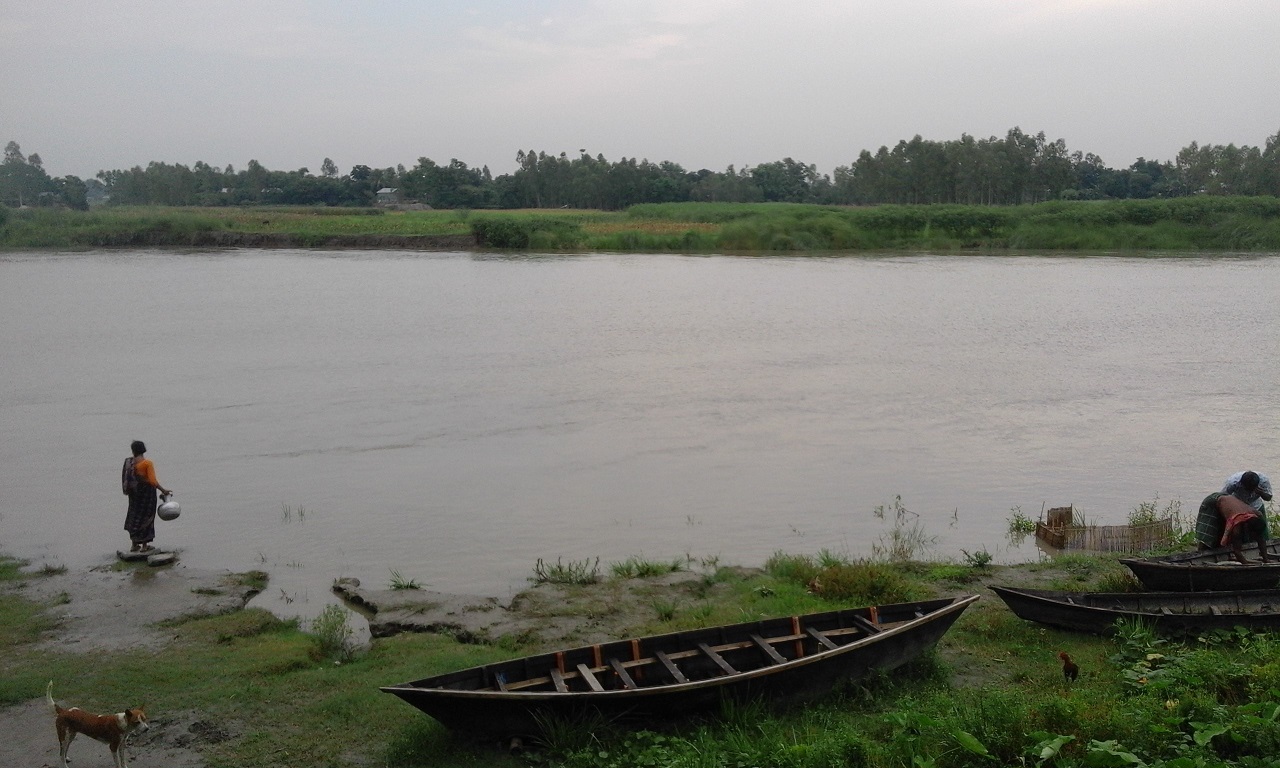
Fishing is physically demanding and uncertain. Many young people dream of easier and more secure lives, away from the hardships of boats, rivers and open fields. Yet the older generation asks a fundamental question: if traditional livelihoods disappear, who will sustain the food systems and ecological knowledge on which rural communities have depended for generations?
Their lives have been shaped by water, wetlands, fields and rivers. They have learned to adapt using resources available around them from jute sticks used as household fuel to gab trees that protect fishing nets. Today, however, both the resources and the ecological systems that support these practices are under pressure.
The story of Gangdubi and Diyal is therefore not simply about the hardship of a few fishing families. It reflects a much larger challenge facing rural Bangladesh: how to protect livelihoods, biodiversity and local knowledge while communities confront an increasingly uncertain climate.
For the elderly fishers sitting beside the shrinking river, the future remains difficult to predict. But their experiences also offer an important lesson: building climate resilience may begin with protecting the natural resources and traditional practices that have sustained communities for generations.