
By Uttam Kumar Sarker and Md. Shahidul Islam from Rajshahi
In Mohor village of Talanda Union, Tanore Upazila, Rajshahi, a farmer’s homestead has gradually become a living learning centre for agroecology, biodiversity, local seeds and farmers’ knowledge. Led by farmer Mohammad Ali with support from BARCIK, the Mohor Agroecological Learning Centre demonstrates how a small household initiative can evolve into a space for learning, exchange and inspiration.
Mohammad Ali began by growing vegetables to meet his family’s food needs. He later integrated local poultry, cattle and goats and began collecting and conserving local seeds. Over time, his homestead developed into a diverse farming system where food, seeds, livestock, plants and local knowledge are interconnected.
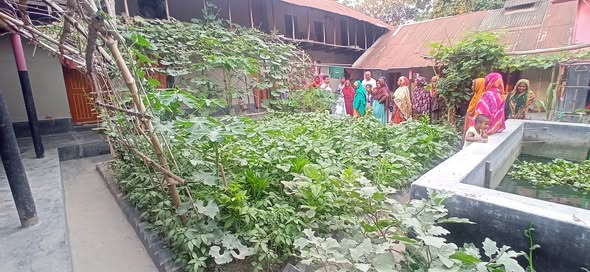
In 2024, his house was formally developed into an Agroecological Learning Centre. Since then, farmers, women farmers, youth, professionals and neighboring villagers have visited the centre to exchange experiences. The centre facilitates seed and seedling exchanges, discussions on environment friendly farming, medicinal plants and local agricultural knowledge.
The homestead now hosts around 15 species of flowers, 30 fruit species and 15 uncultivated plant species, along with medicinal, timber and other local plants. Around 45 varieties of local seeds are conserved, alongside vegetable and horticultural seeds. The centre also practices vermicomposting, sack gardening, natural pest management and environmentally friendly cultivation. Local fish diversity is also of interest to the initiative.
For Mohammad Ali, seeds carry much more than planting material; they embody farmers’ knowledge about soil, seasons, cultivation and preservation. Farmers visiting the centre therefore receive both seeds and practical knowledge on how to conserve, sow and cultivate them. Experience-sharing meetings are also organized in the homestead, allowing farmers to learn from one another.
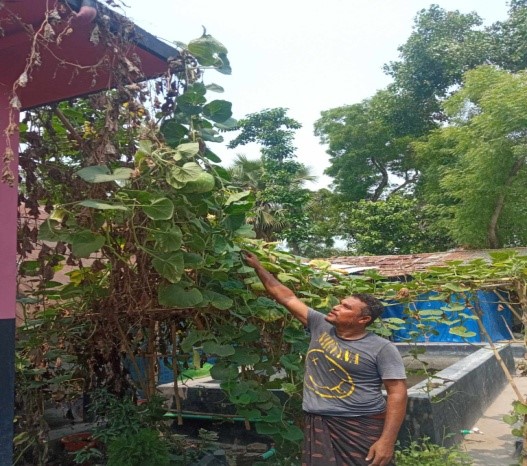
The centre has gradually become a local support and knowledge-sharing platform. A 15-member management committee involving local farmers and women farmers helps to manage the initiative. Members contribute different skills, including seed production, vegetable cultivation, organic fertilizer and natural pest-management practices. Farmers also collectively discuss agricultural problems and, when necessary, connect with government and non-government service providers.
The centre’s contribution extends beyond agriculture. Mohammad Ali maintains a list of villagers’ blood groups to help connect people with potential donors during emergencies. He also assists community members in accessing government services and social support.
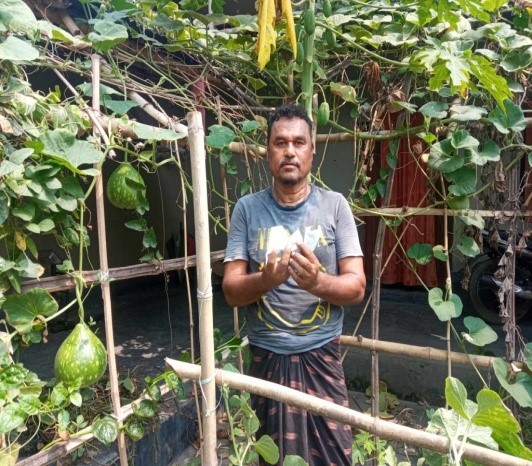
The initiative offers a locally rooted alternative to growing dependence on external agricultural inputs. Beginning with a few vegetables for household consumption, Mohammad Ali gradually developed a system based on seed conservation, biodiversity, livestock integration, natural pest management, organic fertilizer and farmer-to-farmer knowledge exchange.
The story of Mohor Agroecological Learning Centre shows how a farmer’s own knowledge and initiative can become a community learning space. What began as a family food garden has evolved into a place where seeds and knowledge are exchanged, biodiversity is conserved, environment friendly farming is practiced, and farmers learn from one another with continued support from BARCIK.