
By Amreen Binte Azad from Dhaka
BARCIK recently organized a regional dialogue titled “Climate-Resilient Food Systems in Bangladesh: Agroecology Leads the Way” with support from Rosa Luxemburg Stiftung South Asia
Farmers, agricultural professionals, government officials, journalists, youth representatives, development practitioners, cultural activists, and civil society representatives participated in the dialogues and shared their views and concerns.
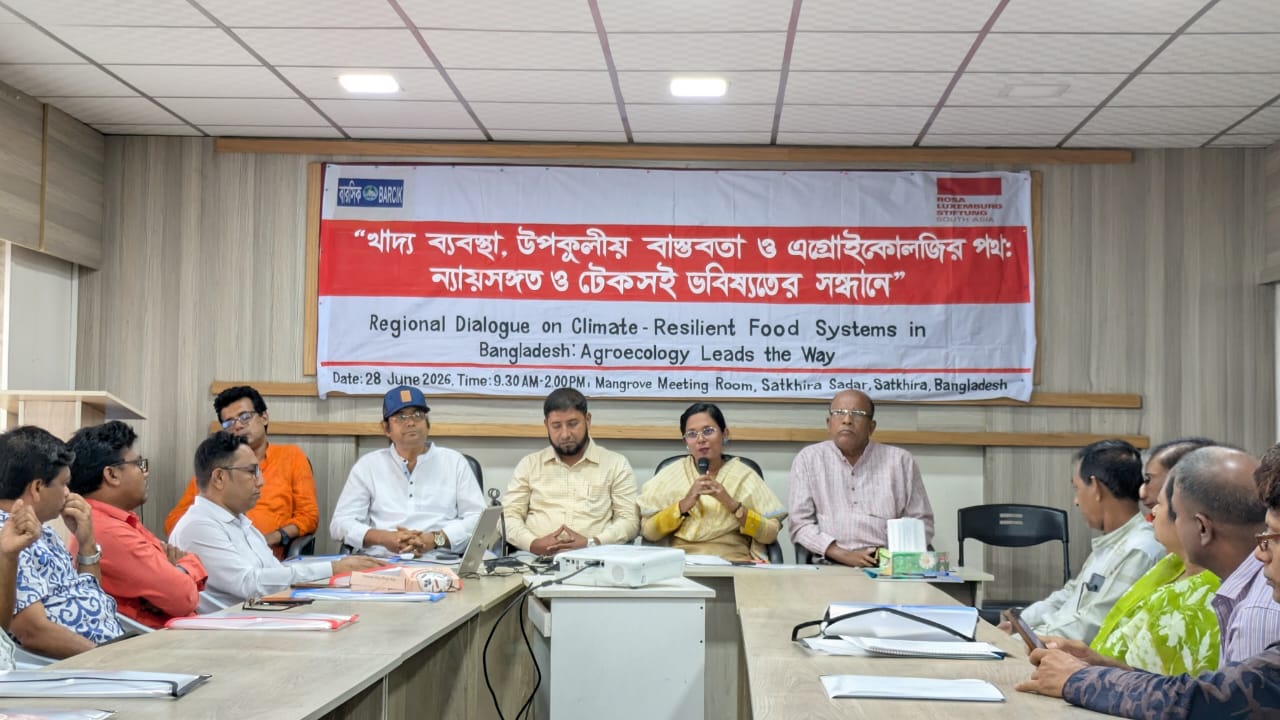
The dialogue was chaired by Abu Affan Rose Babu, President of the Green Coalition, Satkhira District Committee. Agriculture Officer Plabani Sarker and District Information Officer Jaharul Islam attended the programme. BARCIK Regional Coordinator Md. Shahin Islam presented the major challenges affecting coastal food systems and discussed the importance of agroecology.
Key issues of discussions in the dialogue included increasing salinity, climate change impacts, scarcity of safe drinking water, chemical dependency in agriculture, loss of local seeds and agricultural biodiversity, women’s contribution to farming, and the importance of agroecology-based practices.
The discussants put an importance that the coastal food-system crisis is closely connected with soil health, water security, public health, environmental degradation, and farmers’ livelihoods. They highlighted the need to restore rivers and canals, maintain natural water flow, protect freshwater sources, preserve indigenous seeds, reduce the excessive use of fertilizers and pesticides, and expand environmentally friendly integrated farming.
Participants also called for proper land and water-use zoning, improved sluice-gate management, climate-resilient shrimp cultivation, greater recognition of women’s contribution to agriculture, and stronger farmer organizations. They stressed the need for better cooperation among farmers, government institutions, researchers, media, youth groups, and civil society organizations.
The dialogue concluded with a call for coordinated action to protect coastal agriculture, water resources, biodiversity, and local food systems while building a sustainable, climate-resilient, and farmer-friendly food system in Bangladesh.