
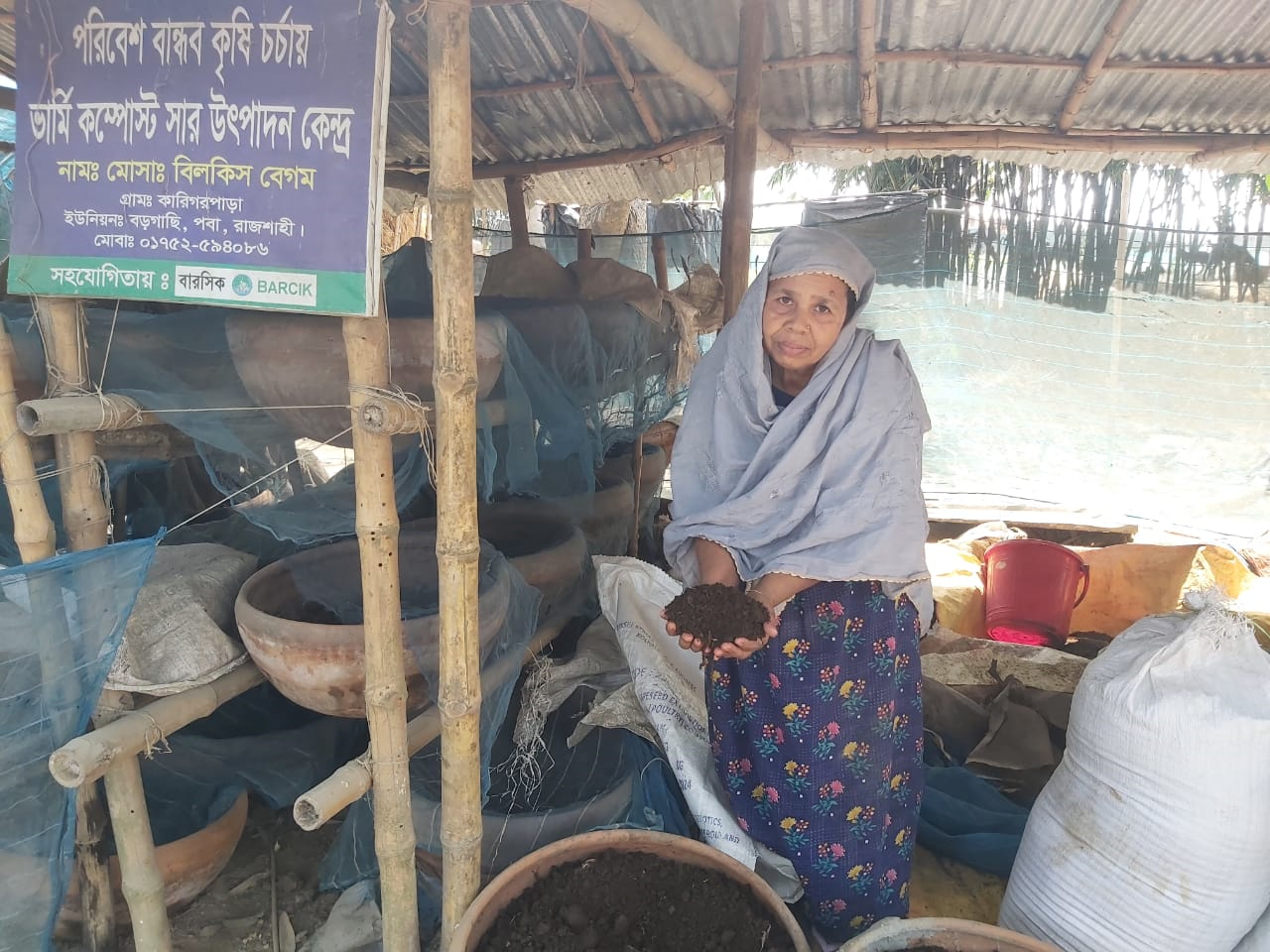
This is the story of a determined woman whose resilience and hard work transformed her family’s financial situation. Bilkis Begum, 55, from Karigor Para village in Paba Upazila, Rajshahi, has rebuilt her family’s financial stability through agroecological practices. Despite her age and challenging circumstances, she has established four vermicompost production units at her homestead. She also grows chemical-free vegetables throughout the year on a small plot of land, meeting her family’s needs and selling the surplus.
Overcoming hardship
In 2015, after her son got married and started living separately, the family managed with the income her husband, Md. Rashid Khan, 60, earned as an agricultural laborer. However, that year, Rashid fell while cutting bamboo beside a pond and broke his leg. As the family’s sole earning member, he became unable to work. Their savings were exhausted by his treatment. The situation worsened when doctors diagnosed him with a serious liver disease. Desperate to arrange money for his treatment, Bilkis took a job as a domestic worker in a neighbouring village. She often spent almost all her earnings on medicines, sometimes going without food for one or two meals a day. To cover her husband’s medical expenses, she borrowed Tk 1 million from 17 organizations and mortgaged two bighas of land. The burden of loan repayments became another major source of distress. Although her husband eventually recovered to some extent, he remained unable to work.
The journey towards recovery
Alongside domestic work, Bilkis began sewing quilts (kantha) to earn additional income. In 2016, a non-governmental organization provided training on vermicompost production. Eager to explore a new opportunity, she attended the training. With just Tk 200 saved from her earnings, she bought an earthen pot (chari) and received 500 earthworms from the organization. Her first batch of compost was used in her vegetable garden. The second batch yielded 10 kg, which a neighbouring woman purchased for Tk 150 after observing the positive results in her garden. As production increased, Bilkis gradually expanded her operation to five earthen pots. Around this time, she came into contact with BARCIK. BARCIK supported her in constructing a large tin-roofed shed and establishing a vermicompost production facility with 50 earthen pots. She began producing approximately five maunds (200 kg) of compost every 20 days. Gradually, she received support from various government and non-government organizations. Today, her vermicompost enterprise generates Tk 25,000–30,000 per month. Through her earnings, she has repaid Tk 1 million loans taken from 17 organizations and redeemed her two bighas of mortgaged land. She has also resumed farming independently, using only vermicompost on her land. Inspired by her success, neighbouring farmers now purchase compost from her. Bilkis has also trained 35 local women in vermicompost production. When large orders arrive, she collects compost from these women, combines their products and supplies buyers, enabling them to earn collectively. Her neighbour, Mosammat Renuka Begum, 45, said, “I started with five earthen pots and 1,000 earthworms from Bilkis Begum. Now I produce compost in 50 pots. When we receive large orders, we combine our compost, sell it together and share the earnings.” Her garden supplies vegetables for the family, with the surplus sold for additional income. Her initiatives have significantly contributed to promoting environment friendly agriculture in the locality.
Recognition and inspiration
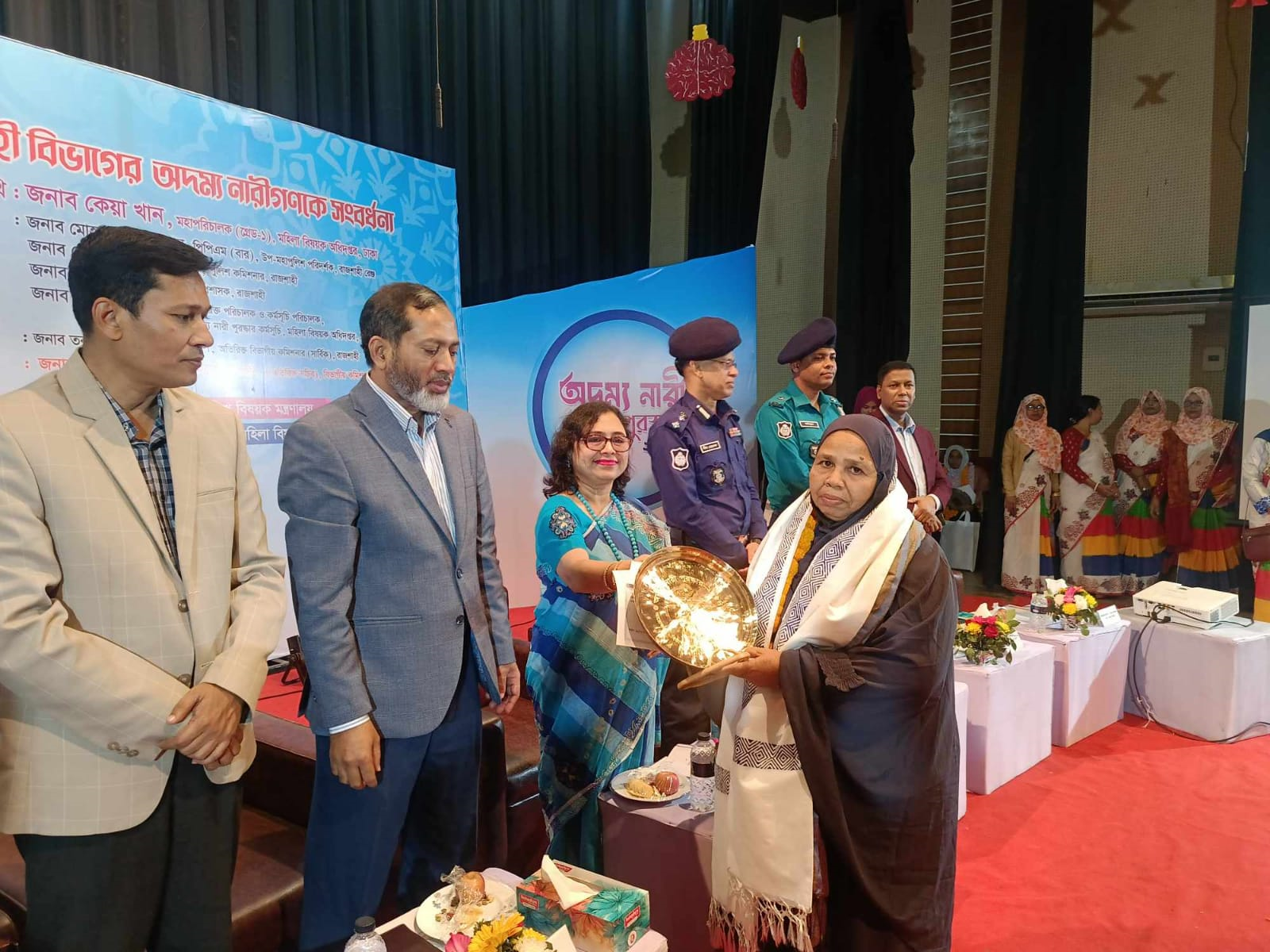
Bilkis’s inspiring journey was published in leading national newspapers, increasing demand for her vermicompost. In 2024, she received the Joyeeta Award as the best woman at the district level. In 2025, she received the Divisional Indomitable Woman Award. These recognitions have further encouraged her to expand her work and support other women. Bilkis considers these honors a source of inspiration for women facing similar challenges. She believes determination and timely support can transform lives. “Nothing is impossible if you have the determination to move forward. Many disadvantaged women like me can succeed if they receive a little support and encouragement. Through my work, I want to help other women move forward and become economically self-reliant,” she said.